
The distinction between being “AI decorated” and “AI native” is not semantic—it represents a fundamental chasm in how organizations approach artificial intelligence. The difference determines whether AI becomes a competitive advantage or remains a costly experiment. Most traditional enterprises today occupy the uncomfortable middle ground: they have deployed AI pilots, launched interesting proof-of-concepts, and achieved impressive headlines. Yet fewer than 5% of these AI initiatives translate into meaningful business value.
Understanding the Current State
Traditional enterprises currently operate in what researchers call an “AI decorated” state. These organizations treat artificial intelligence as an enhancement to existing processes rather than a reimagining of those processes. They apply AI selectively—a chatbot here, a predictive model there—without fundamentally restructuring how work flows, decisions are made, or value is created. The numbers reveal the challenge: 78% of organizations now use AI in at least one business function, up from 55% a year earlier. Yet this rapid adoption masks a troubling reality. According to MIT’s analysis of over 300 public AI deployments, while 80% of organizations explore AI tools, only 20% launch actual pilots, and a mere 5% achieve production success with measurable ROI.
This gap exists because AI decorated organizations maintain a project-based mentality. They form dedicated innovation teams, carve out budgets for experimentation, and celebrate successful pilots. But then scaling fails. They encounter organizational silos, legacy system incompatibilities, governance roadblocks, and a workforce unprepared for the changes AI demands. The costs mount quickly—integration challenges with legacy systems are cited as barriers by 49% of organizations, while inadequate data infrastructure is identified by 68% of respondents.
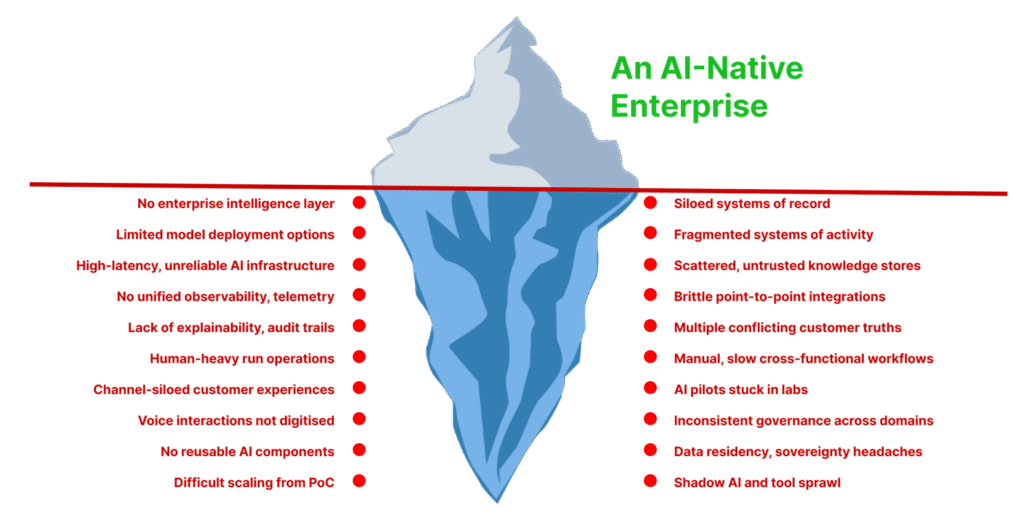
The True Difference: Architecture and Intent
An AI native organization is fundamentally different. It is not a company that happens to use advanced artificial intelligence. Rather, it is one designed from the ground up with intelligence as an organizing principle. In AI native enterprises, artificial intelligence is not a feature—it is the foundation. This distinction manifests across seven critical dimensions: approach, technology, data, governance, expertise, team structure, and organizational alignment.
Consider approach first. AI decorated organizations follow a traditional change management model: identify a use case, run a pilot, measure results, then scale if successful. This linear progression assumes that what works in a lab will work in production, which rarely holds true for enterprise AI. AI native organizations, by contrast, embed continuous learning and iteration into their operating model. Decisions are made closer to ground-level, informed by real-time models and data flows rather than historical reports. Teams work according to product-based approaches where continuity prevails over project-based episodic efforts.
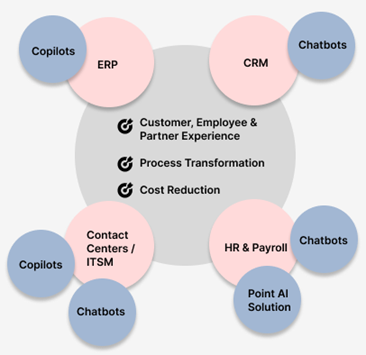
The technological architecture differs equally. AI decorated enterprises bolt artificial intelligence onto existing systems—ERP platforms, CRM tools, legacy databases. This generates what researchers call “shadow AI,” where employees deploy unapproved generative AI tools (reported by 55% of users) because official systems are too rigid, too slow, or too governed. AI native organizations, conversely, rearchitect their technical foundations from first principles. Data flows naturally across the organization. Systems are modular rather than monolithic. Models evolve continuously rather than through quarterly retraining cycles.
The data challenge is perhaps most acute. AI decorated organizations maintain fragmented data landscapes where information resides across dozens of incompatible systems and databases. These silos prevent the kind of unified, trusted data foundation that makes AI powerful. AI native organizations solve this differently. Rather than forcing all data into a single repository (which proves prohibitively expensive and operationally complex), they create unified data access protocols that bring intelligence to the data. Platforms that can connect to hundreds of data sources and aggregate them into a seamless knowledge layer enable this architectural shift.
Quantifying the Business Impact
The financial returns separating AI decorated from AI native are substantial. Organizations implementing comprehensive AI-driven cost reduction achieve average savings of 35-45% in operational expenses, with 32% reductions in operational costs and 28% in administrative costs within the first year of full implementation. But these results accrue only to those pursuing systematic, enterprise-wide transformation, not isolated pilots.
Labor productivity improves dramatically in AI native environments. Companies automating routine tasks see employees save an average of 2.5 hours per day. In specific domains, the gains are even more pronounced. Manufacturing organizations deploying AI-powered predictive maintenance reduce downtime by up to 50%. Customer service teams using AI tools handle 13.8% more inquiries per hour, with service professionals saving over 2 hours daily through quicker response times. Financial services firms report that AI-enabled customer service teams save 45% of time spent on calls and resolve issues 44% faster with fewer errors.
Quality improvements are equally quantified. Supply chains leveraging AI achieve 20-30% improvements in demand forecasting accuracy and 30-50% reductions in inventory costs compared to traditional methods. At the organizational level, companies like JP Morgan Chase reduced financial losses through AI-driven fraud detection by 50%. Nissan’s AI-powered quality control systems detect defects with 50% greater accuracy than human inspectors, substantially reducing product defects and recalls.
Revenue growth reflects these operational gains. Amazon’s AI-driven recommendation systems account for 35% of total revenue. Tesla achieved 40% revenue growth through AI-powered autonomous driving and smart manufacturing. Walmart increased revenue by 22% while reducing operational costs by 25% through AI-driven inventory management and personalized marketing. These results emerge not from isolated AI applications but from systematic integration of AI throughout the enterprise.
The time required to achieve ROI reveals maturity differences. AI decorated organizations often see ROI timelines of 18-24 months if they succeed at all, with the majority never reaching production. AI native enterprises compress these cycles. Among the Wharton AI Adoption Report’s cohort of maturing organizations, 72% formally measure AI ROI, focusing on productivity gains and incremental profit, with three out of four leaders reporting positive returns. When enterprises approach AI systematically, they accelerate success: companies achieving 20% cost reductions demonstrate this within months, not years.
The Maturity Journey: From Experimental to Systematic
How do enterprises transition between these states? Maturity models reveal a structured progression.
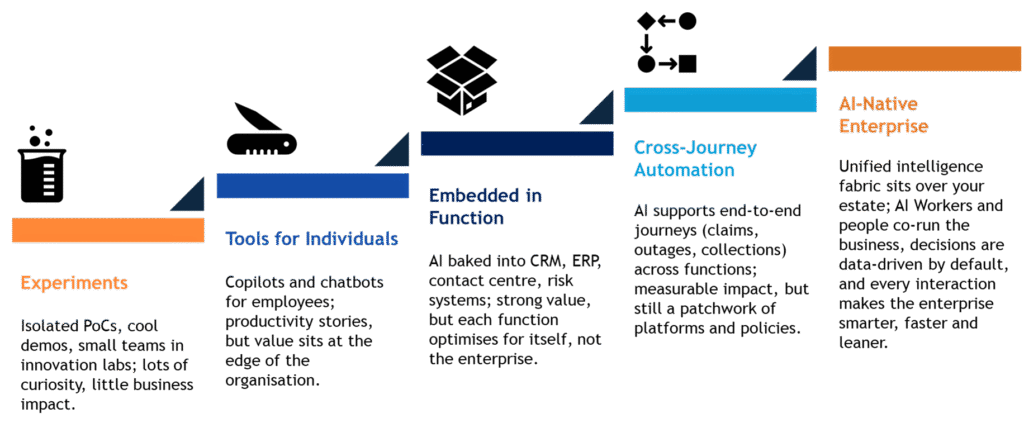
Most traditional enterprises today occupy the Experimental stage. They have moved beyond ad-hoc dabbling into structured pilots. But the critical bottleneck emerges at Systematic maturity. Transitioning here requires investments in data architecture, talent, and governance that feel disproportionate to pilots demonstrating 15-25% improvements. The challenge, however, is that this intermediate investment unlocks exponential returns at the Strategic and Pioneering stages.
AWS’s Generative AI Maturity Model captures similar territory across four levels: Envision (building awareness and identifying use cases), Experiment (validating potential through pilots), Launch (deploying production-ready solutions with governance), and Scaling (establishing enterprise-wide capabilities). The progression is not inevitable. Two-thirds of companies remain stuck in proof-of-concept, unable to transition to full operation. For every 33 AI prototypes built, only 4 reach production—an 88% failure rate.
Organizations that successfully navigate this transition share several characteristics. First, they secure executive sponsorship that transcends individual projects. When a top executive declares, “we’re going to deploy this across all stores,” the project gains necessary momentum. Without this backing, AI efforts languish in labs. Second, they build cross-functional teams from the outset, embedding business stakeholders alongside technologists. When business unit leaders co-own pilots, they invest in scaling success. Third, they prioritize data foundation investment before model proliferation, recognizing that AI is only as powerful as the data it learns from.
Organizational Structure and Cultural Transformation
AI native transformation demands fundamental changes to organizational design. In AI decorated organizations, AI specialists work in dedicated innovation units, separate from business operations. This separation enables experimentation but prevents scaling. AI native enterprises flatten these boundaries. As organizations progress through maturity stages, roles that seemed essential at earlier stages—dedicated AI experts, heads of AI, specialized teams—become absorbed into existing functions.
This reflects a cultural shift. In AI decorated organizations, AI is treated as special, subject to steering committees, governance frameworks, and transformation initiatives. In AI native organizations, AI is treated as a commodity—ubiquitous, embedded, transparent. It “has no special status,” requires no steering committee, and demands no specific strategy because the organization is fundamentally designed to leverage it. Everyone is accountable for AI outcomes, not just a few practitioners.
The workforce impact is substantial but often misunderstood. Wharton’s longitudinal research shows that while 89% of leaders agree AI enhances employees’ skills, 43% simultaneously see risk of declining proficiency in replaced skills. Successful AI native organizations address this through continuous reskilling. Rather than displacing workers, they redeploy them toward higher-value activities. A bank’s AI chatbot may handle 30% of customer inquiries, but the human agents freed from routine work now focus on complex problem-solving and relationship-building, actually improving customer satisfaction while reducing costs.
Real-World Examples of the Transition
Microsoft’s 1,000+ customer case studies illuminate this transition across industries. Motor Oil Group completed tasks in minutes that previously took weeks after integrating Microsoft 365 Copilot into workflows. Petrobras created Chat Petrobras to streamline processes and reduce manual tasks for 110,000 employees. Toshiba deployed Copilot to 10,000 employees, confirming savings of 5.6 hours monthly per employee, and identified process improvement areas that might otherwise have remained hidden.
These results emerge not from Copilot itself but from how organizations fundamentally restructured work around AI capabilities. Similarly, Salesforce’s strategy—embedding autonomous agents directly into CRM workflows supported by unified customer data—delivers substantially different results than organizations bolting Copilot onto existing processes. Salesforce customers switching from Microsoft report 34% increase in ROI, 30% increase in productivity from generative AI, and 32% increase in sales revenue. Source: klover
McDonald’s China exemplifies the transformation arc. The company chose Microsoft Azure AI, GitHub Copilot, and Azure AI Search to transform operations. The impact: employee transactions increased from 2,000 to 30,000 per month, driven by AI-powered capabilities fully integrated into operations rather than applied as peripheral enhancements. Source: microsoft
Among mid-market firms, the competitive dynamics are even more dramatic. A manufacturing company deploying AI for quality control achieved 85% reduction in defects (from 0.8% to 0.12%) within 90 days and reduced downtime by 85%. The system processes 15,000 quality checkpoints per hour—five times faster than manual inspection—enabling 20% faster delivery times. Within six months, the company secured $12 million in aerospace contracts. This company transformed itself from AI decorated (sporadic quality improvements) to AI native (intelligence embedded in every production decision). Source: maccelerator
Key Barriers and How to Overcome Them
The transition from AI decorated to AI native encounters predictable obstacles. The most frequently cited barrier is inadequate data infrastructure (68% of organizations), followed by lack of AI expertise (54%) and integration challenges with legacy systems (49%). Organizations overcoming these barriers focus on specific, high-impact use cases first rather than attempting broad transformation simultaneously.
Process automation leads successful deployments, with 87% success rates. Predictive maintenance follows closely at 82%, and demand forecasting achieves 76%. These successes create momentum and internal examples that ease subsequent transformations. They also provide immediate ROI that justifies further investment.
The governance question is critical. Organizations cannot succeed through either extreme: completely decentralized AI efforts create chaos, inconsistency, and governance risks. Overly centralized approaches create bottlenecks that prevent business units from deploying solutions quickly. Successful AI native organizations employ hybrid governance models where teams closest to business problems own solutions, while central teams provide platforms, guardrails, and technical standards.
The Strategic Imperative
The market is ruthlessly punishing delay. By 2030, the enterprise AI market will grow from $24 billion in 2024 to $150-200 billion, with compound annual growth rates exceeding 30%. In this expanding landscape, AI native enterprises gain compounding advantages. Each iteration yields more data, better models, and faster decision-making. Each month of delay costs organizations ground they may never recover.
The transition from AI decorated to AI native is not a technology problem awaiting superior tools. It is an organizational challenge requiring leadership conviction, structural change, cultural transformation, and sustained investment. Organizations that embrace this journey—unifying data foundations, systematizing AI deployment, embedding intelligence throughout workflows, and aligning organizational structures accordingly—position themselves not just to survive the AI era but to define it.
For traditional enterprises, the question is no longer whether to transform but how rapidly they can complete the journey. The 5% of organizations achieving AI maturity demonstrate that the path is navigable. The 95% who remain in AI decorated or experimental stages face an ever-widening competitive gap that will prove increasingly difficult to close.
Leave a Reply