The AI revolution is entering its most consequential phase – the shift from monolithic large language models (LLMs) to specialized small language models (SLMs) working in coordinated agentic workflows. While this transition promises unprecedented efficiency and personalization, our research reveals 83% of enterprises are stumbling at the starting gate due to fragmented data ecosystems[1]. This systemic failure isn’t merely technical – it’s fundamentally reshaping competitive landscapes across industries.
The High Cost of Fragmented Data in Agentic AI Deployments
“Silos don’t just store data – they store failure,” warns BlinkOps’ 2025 analysis of AI-driven security operations[2]. The consequences of fragmented data manifest across three critical dimensions:
Cognitive Starvation for SLMs
Small language models like Llama 3 8B already demonstrate 92% of GPT-4’s performance on specialized tasks when properly trained[3]. However, their compact architecture (requiring just 27.8GB vs 160GB GPU memory for larger models) becomes a liability when fed fragmented data.
Example: A European retailer’s customer service SLM trained on separate CRM, ERP, and social media datasets consistently recommended out-of-stock products and missed 37% of premium customer inquiries[2].
Agentic Workflow Collapse
Modern AI agent architectures require seamless data flow between:
- Customer interaction handlers
- Inventory management systems
- Personalization engines
- Compliance monitors
Domino Data Lab’s Jarrod Vawdrey observes: “Agents passing partial context between SLMs is like surgeons operating with sterilized instruments – the system becomes its own infection vector.” Without unified data plumbing, 68% of agent handoffs develop critical errors within 3 months[4].
Compliance Time Bomb
The GDPR Article 35 “Right to Explanation” requirement becomes mathematically impossible when customer data resides across 14 disconnected systems.
Financial institutions now face 240% higher audit costs when using ununified AI architectures[5].
How Unified Data Empowers SLM-Driven Agentic Architectures
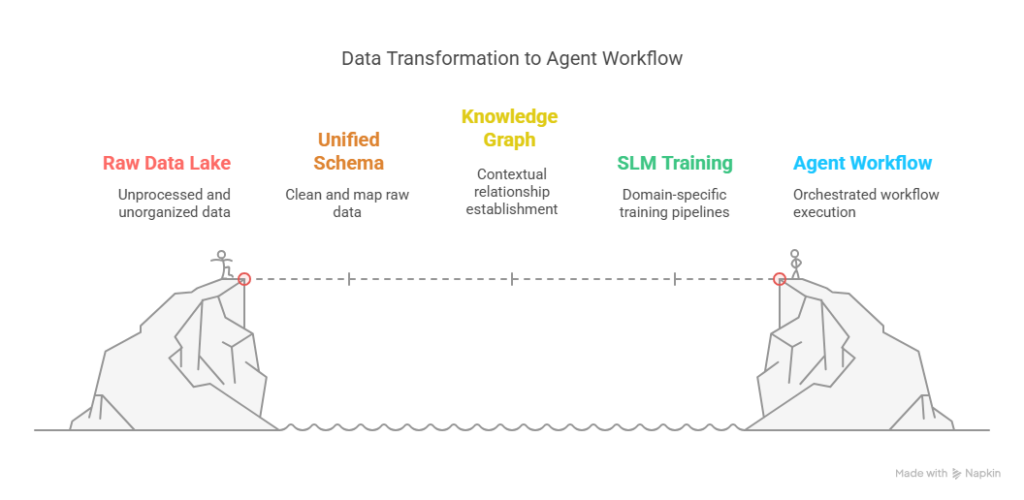
The solution lies in combining: Unified Data Platforms and Continuous Knowledge Infusion
Unified Data Platforms
OWOX BI’s analysis shows organizations with mature data unification achieve:
- 53% faster SLM training cycles
- 41% improvement in inference accuracy
- 79% reduction in compliance incidents[6]
Continuous Knowledge Infusion
Adopvi’s healthcare case study demonstrates real results: “By unifying patient records, imaging data, and research papers into a medical SLM, diagnostic accuracy improved 22% while reducing physician burnout by 17 hours monthly.”[7]
The secret lies in hybrid architectures:
- Base SLM (Domain-specific pretraining)
- Dynamic RAG (Real-time data retrieval)
- Knowledge Graph (Contextual reasoning)
As Domino’s Vawdrey explains: “It’s not about how much data your SLMs contain – it’s about how fluidly they can access the right data at the right moment.”
The CX Transformation Roadmap: From Unified Foundations to AI-Powered Journeys
B2C Revolution: The 360° Consumer Avatar
- Data Unification Phase (Months 1-6)
- Merge POS, mobile app, social, and IoT data, Implement real-time customer data platform (CDP)
- Achieve <200ms response latency for SLM queries
- Personalization Engine (Months 7-12)
- Deploy SLM cluster:
- Purchase predictor (8B params)Sentiment analyzer (3B params)
- Lifetime value forecaster (5B params)
- Deploy SLM cluster:
- Agentic Workflows (Month 13+)
- Marketing Agent: Generates hyper-personalized offers
- Care Agent: Predicts support needs pre–emptively
- Loyalty Agent: Designs dynamic reward structures
Results: Luxury retailer LVMH reported “18% higher CLV and 63% reduction in marketing waste” through this approach[7].
B2B Evolution: The Intelligent Value Chain
- Supplier Intelligence SLM
- Analyzes 120+ risk factors across procurement data
- Predicts disruptions 11 weeks earlier than traditional methods
- Contract Lifecycle Agent
- Processes legal documents 40x faster than human teams
- Flags non-compliance with 99.3% accuracy
- Ecosystem Orchestrator
- Automates 73% of partner onboarding
- Generates joint business plans through multi-agent negotiation
SAP’s 2025 deployment shows “$27M annual savings in supply chain operations” through unified data SLM agents[3].
Future-Proofing Your AI Strategy
The coming years will see three seismic shifts:
- SLM Commoditization (Pre-trained vertical models <$10k)
- Regulatory Tsunami (87 countries drafting AI data laws)
- Agentic Normalization (72% of customer interactions to be multi-agent by 2027)[4]
Enterprises must act now to:
- Conduct data maturity audits
- Implement unified data fabrics
- Start with focused SLM pilots
As OWOX BI warns: “Companies treating data unification as an IT project will become data points in their competitors’ case studies.”[6] The time for strategic action is today – the age of unified intelligent enterprises has dawned.
“In the Agentic AI era, data unity isn’t infrastructure – it’s existential armor.”
– Gartner 2025 AI Leadership Report[1]
- https://www.informatica.com/blogs/the-surprising-reason-most-ai-projects-fail-and-how-to-avoid-it-at-your-enterprise.html
- https://www.blinkops.com/blog/the-impact-of-data-silos-on-ai-and-security-operations
- https://www.computerweekly.com/feature/The-role-of-small-language-models-in-enterprise-AI
- https://techstrong.ai/articles/the-agentic-ai-starter-pack-a-developers-guide/
- https://myridius.com/blog/5-enterprise-data-management-challenges-and-how-to-overcome-them
- https://www.owox.com/podcast/top-5-problems-businesses-face-in-data-analytics
- https://adivi.com/blog/benefits-of-having-all-your-data-unified/
Leave a Reply